

We have all been there: it’s midnight, you’re sleepy, and you click the “off” button on your air conditioner (AC) remote. The red LED glows, the humming stops, and you drift off to sleep. But while the cooling has stopped, the voltage stabilizer is still humming away on the wall, and that little red light on the AC is still shining.
Is this “silent” operation draining your wallet? How much electricity does an AC consume when it’s turned off by the remote but the main power is still on? Let’s break down the math and the science behind phantom loads.
What is Standby Mode (Phantom Load)?
When you turn off an AC with a remote, it doesn’t truly “shut down.” It enters Standby Mode. In this state, the AC’s internal circuit board (PCB) stays active so it can “listen” for the next signal from your remote.
Similarly, a voltage stabilizer is an active device. Even if the AC isn’t drawing heavy current to run the compressor, the stabilizer’s internal transformer and circuitry stay energized to monitor the incoming voltage. This constant, low-level power draw is known as a Phantom Load.
The Calculation: How Many Watts Are You Losing?
If you leave a 1.2 Ton AC and its dedicated stabilizer on for 7 hours (say, from 12:00 AM to 7:00 AM) without actually running the cooling, here is the approximate power consumption breakdown:
1. The Voltage Stabilizer
A standard digital or analog stabilizer for a 1.2 Ton to 1.5 Ton AC typically consumes between 10W to 15W just to stay powered on. This is due to “no-load losses” in the copper coils and the electronic display.
2. The AC Unit (Standby)
A modern split AC in standby mode (with the red LED on) consumes roughly 5W to 7W(depending on the specific model and energy rating)). This powers the infrared receiver and the micro-controllers.
The Total Math:
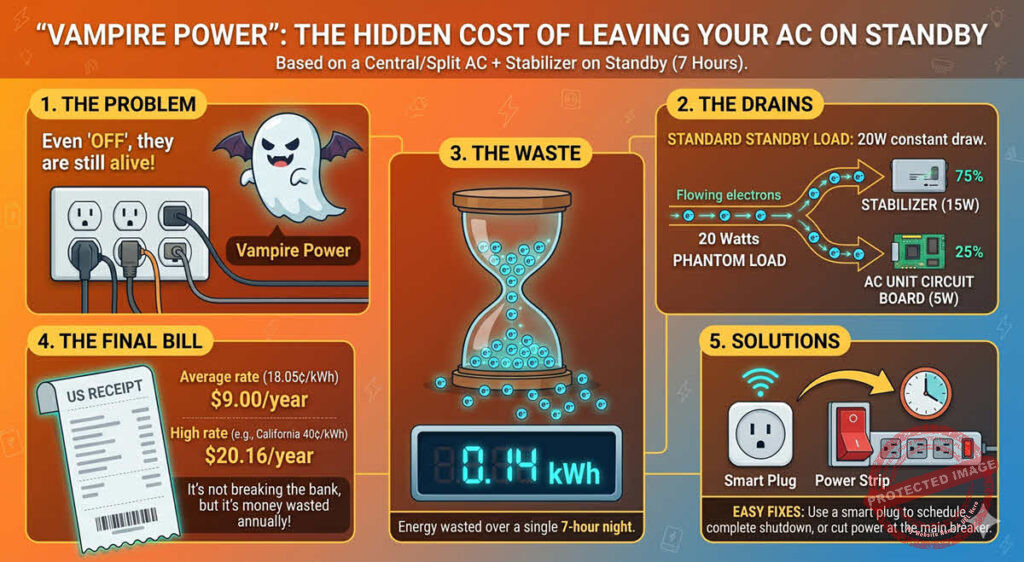
- Total Power Draw: 15W (Stabilizer) + 5W (AC) = 20 Watts
- Duration: 7 Hours
- Total Energy Consumed: 20W x 7 Hours = 140 Watt-hours (Wh)
- Units (in kWh): 140 / 1000 = 0.14 Units
The Financial Impact: If You Are in India
In India, electricity is billed in “Units” (1 Unit = 1 kWh), and the price varies significantly based on your state and your consumption slab.
- National Average Rate: Approximately ₹7.20 per unit.
- High-Slab/Metro Rate: In cities like Mumbai or Delhi, if you consume a lot of power, you could be in the ₹12 to ₹15 per unit range.
The Cost of “Standby” in India:
| Time Period | At Average Rate (₹7.20) | At High Slab Rate (₹15.00) |
| One Night (7 hrs) | ₹1.01 | ₹2.10 |
| One Month | ₹30.30 | ₹63.00 |
| One Year | ₹363.60 | ₹756.00 |
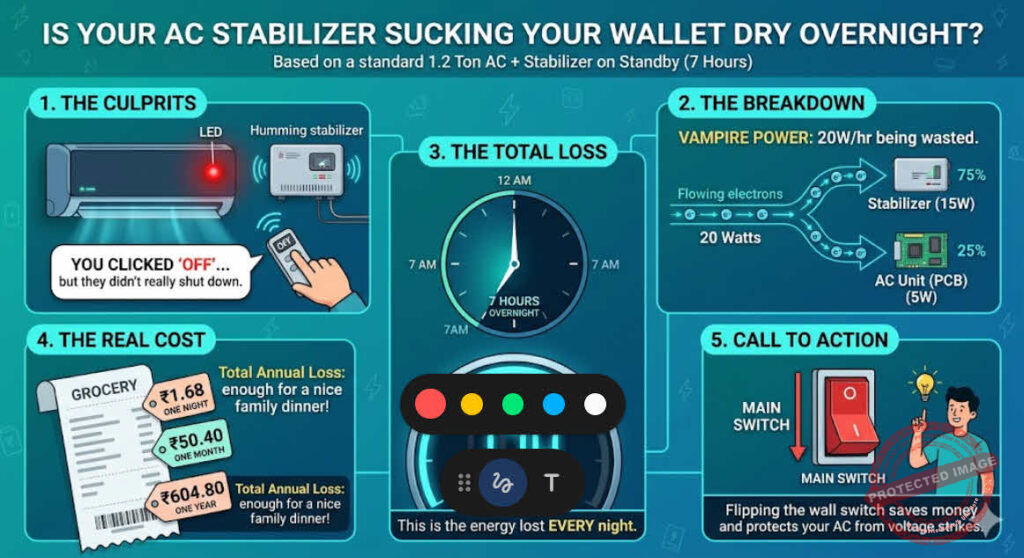
The Bottom Line (India): While ₹1 a night sounds tiny, if you have three ACs in your house, you are throwing away over ₹1,000 to ₹2,000 every year just to keep the “red lights” on. That is enough to pay for a minor AC service or a couple of months of a streaming subscription! Refer National Energy Data Survey & Analysis.
The Financial Impact: If You Are in the United States
In the U.S., electricity rates have seen a steady climb. Prices are measured in cents per kilowatt-hour (¢/kWh).
- National Average Rate: Approximately 18.05¢ per kWh. Refer latest data from the EIA.
- High-Cost States: In places like Hawaii, California, or Massachusetts, rates can soar between 30¢ to 40¢ per kWh.
The Cost of “Standby” in the USA:
| Time Period | At Average Rate (18.05¢) | At High Rate (40¢) |
| One Night (7 hrs) | $0.025 | $0.056 |
| One Month | $0.75 | $1.68 |
| One Year | $9.00 | $20.16 |
Does It Harm the Equipment?
Aside from the minor electricity cost, there are two other factors to consider:
- Component Wear: Leaving the stabilizer on 24/7 keeps the internal components warm. While they are designed for this, constant heat can slightly reduce the lifespan of the capacitors over many years.
- Safety: In areas with frequent lightning or severe voltage surges, an active stabilizer is the “first line of defense.” If it’s on, it’s vulnerable. Turning it off at the main switch provides a physical break in the circuit, protecting your expensive AC from unforeseen electrical strikes.
Pro Tips to Save Energy
- Kill the Switch: The simplest way to save is to turn off the main power switch or MCB after turning off the AC with the remote.
- Smart Plugs: If your switch is hard to reach, consider a high-power smart plug. You can schedule it to cut power entirely at a specific time.
- Maintenance: Ensure your stabilizer is kept in a well-ventilated area. Dust buildup can increase internal resistance, leading to higher “no-load” power consumption.
Whether you are in Lucknow or Los Angeles, the principle remains the same. This is “Vampire Power”—energy that is sucked out of your home without providing any cooling or comfort.
By simply flipping the physical wall switch after you turn off the remote, you protect your electronics from power surges and keep that extra cash in your pocket. It’s the easiest “green” habit you can start tonight!

Awill Guru is a technology enthusiast with degrees in VLSI Engineering (B.Tech, M.Tech) and Android Development. Their passion for education drives them to teach and share knowledge through their blog. He also hold qualifications in Sociology (M.A.) and Education (B.Ed), along with NIELIT O and A Level certifications.